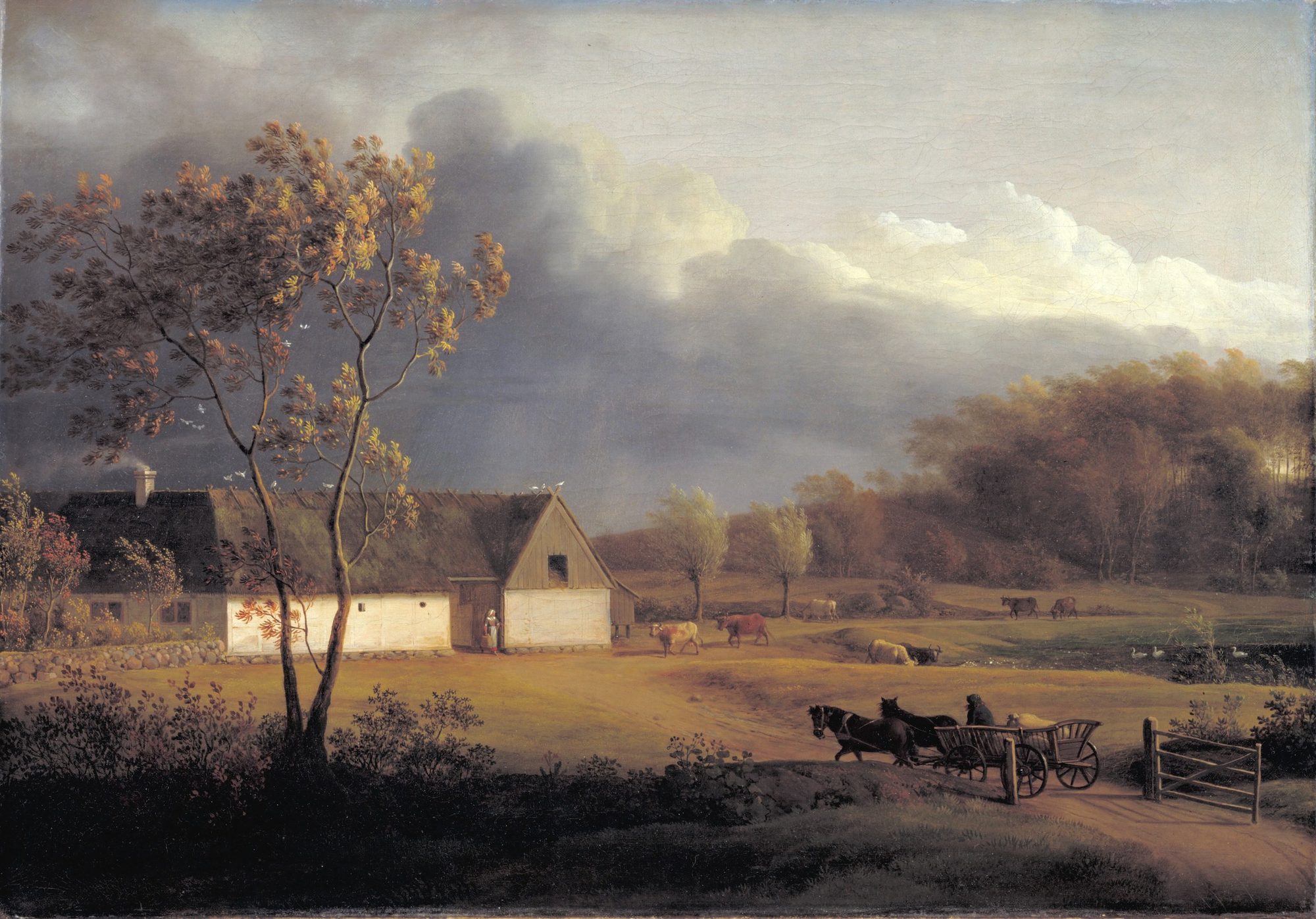
Legend from the area
The King's Oak and the Parson's Wife
Two oaks beside the old road to Gåbense. Under one, lightning struck right where the king had been sitting. At the other, the parson's wife's thread ran out.
Before the new highway was built, the road from Nykøbing to Gåbense ferry crossing wound in countless bends across North Falster. It ran through Kraghave, past Flattehauge Forest and towards Bruntofte - and from there into Ønslev parish, right past the Gallows Inn and the district's place of execution. Along that road stood two great oaks, and each has its own legend attached.
The King's Oak
One of the old kings - some said Christian V, others Frederik IV - was once travelling along the road from Gåbense towards Nykøbing. Along the way the company stopped, and the king ate his lunch in the shade of a mighty, solitary oak west of the road, before reaching Bruntofte Forest.
When the meal was over, the company moved on. But the king had hardly gone a few fathoms from the tree before lightning struck the oak. It split off a heavy branch and drove it into the ground - precisely where the king had been sitting.
In memory of the king's narrow escape from so imminent a danger, the tree was named the King's Oak. And in the parish everyone agreed on one thing: that tree must never be felled.
The Parson's Wife
In the days when the Dowager Queen Sophie "ruled" on Falster, she did much to promote home crafts, and there was talk of who could spin the finest thread. The parson's wife in Vålse, Karen Hansdatter, undertook to spin a thread from a pound of flax so fine and so long that it could reach all the way from Vålse to Nykøbing.
She tied the end fast at Vålse vicarage, took up her spinning and walked. Over Kippinge, over Brarup, past Ønslev Church and across the Tingsted parish boundary - to a great oak in Hans Mortensen's field. There the thread ran out. There was still a whole mile left to Nykøbing.
The oak she reached was afterwards named the Parson's Wife.
The Dowager Queen at Nykøbing Castle
Dowager Queen Sophie was the widow of Frederik II and mother of Christian IV. She held Lolland and Falster as her dower lands and lived for decades at Nykøbing Castle, where she became known as an unusually capable manager of her estates. It is the same castle that, according to tradition, two of Byskov's farms once had to supply watchmen for - and the same castle that the three windows in Vægtergården's Mill Room come from.
Source: J.K. Lindberg's recorded legends, reprinted in Ketty Lykke Jensen, Ønslev og Eskilstrup Sogne (2009), p. 186. Retold. Painting: Jens Juel, SMK.