The story behind the name
Why Vægtergården?
Two farms in Byskov were bound to supply watchmen to Nykøbing Castle - or so the family's own account of the name goes.
There is only one farm in Denmark called Vægtergården. The name was officially registered in 1922, but it is far older: it comes from the Vægter family - "Watchman" - who held the farm from at least around 1716 until 1919.
Watchmen for the castle
Within the Vægter family it was said that the name arose because two farms in Byskov were obliged to supply watchmen to Nykøbing Castle. In the 1600s the castle served as a dower residence for queens and was one of the realm's grand estates - it was demolished in 1766.
That fits well with the fact that in 1841 two farmers named Vægter held land in Byskov: Hans Vægter on our farm and Peter Vægter on the neighbouring farm further down the road. And P. Petersen's Lolland-Falsters Navnebog (Lolland-Falster's Book of Names) from 1902 records the byname "Vægter (Vægder)" in Byskov for the period 1688-1900.
Whether the story is true, we don't know. No written source confirms the watchman's duty - but it is too good a tale not to tell.
The other Vægter farm
The other farm bound by the watchman's duty lay a little further down the road, on what is today Klodskovvej 56. In 1841 Peter Vægter held it. He was the only member of the parish council to vote against the council's plan to buy a poorhouse, because it would stand right next to his farm. In 1863 Mads Pedersen Vægter bought the farm free for 7,000 rigsdaler.
In 1900 lightning struck the farm during a violent storm. That night, ten fires could be seen across Falster and East Lolland from Byskov, and Mads Pedersen Vægter, taken ill, had to be carried out of the burning farmhouse. At the time it stood close by Vægtergården's garden. It was rebuilt where it stands today, and was given the largest hall in Byskov and Klodskov. Here the farmers held their gammelgilde - the old harvest feast.
Bynames that stayed with the farm
On Lolland-Falster in the 1600s and 1700s it was common for a farmer to be given a byname after his occupation or station, and for the name to stay attached to the farm. When a new man married into it, he took the name with him - just as Hans Larsen did when he became Hans Larsen Vægter in 1817.
What did a watchman do?
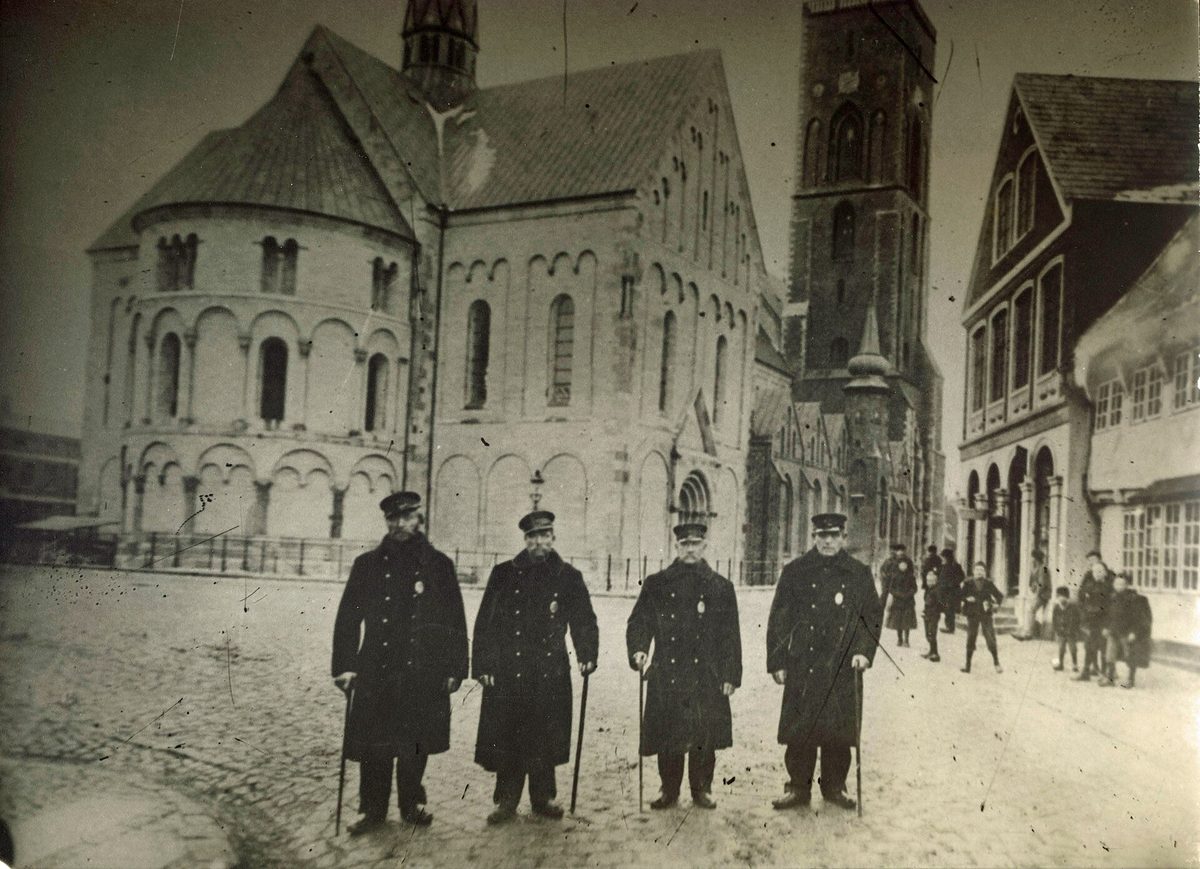
Watchmen walked the streets of the town at night with a lantern and a morning star (a spiked mace). They kept watch for fire and disorder and called out the hours with a verse. Denmark's market towns were given permanent watchmen's corps in 1683, and the practice continued until the 1860s. In the countryside and along the coasts, farmers kept watch at the beacons - the signal fires - especially during the wars of 1807-14.
The watchman's verses
The watchman's verses are attributed to the hymn-writer Thomas Kingo. There was a verse for every hour from eight in the evening until four in the morning:
Ho, watchman! The clock has struck ten.
If you would know the hour,
master, maid and boy,
now is the time
to take yourselves to bed.
Commend yourself to the Lord!
Be wise and shrewd!
Guard light and flame!
Our clock has struck ten.
Ho, watchman! The clock has struck four.
Eternal praise to You, God,
in the high choirs of heaven,
who chose to be a watchman
for us who dwell on earth.
Now up to the morning watch!
For the good night
fall at God's feet,
and keep good heed of time!
The lantern in our logo is a nod to them - and to all the nights when someone has kept watch over the farm.