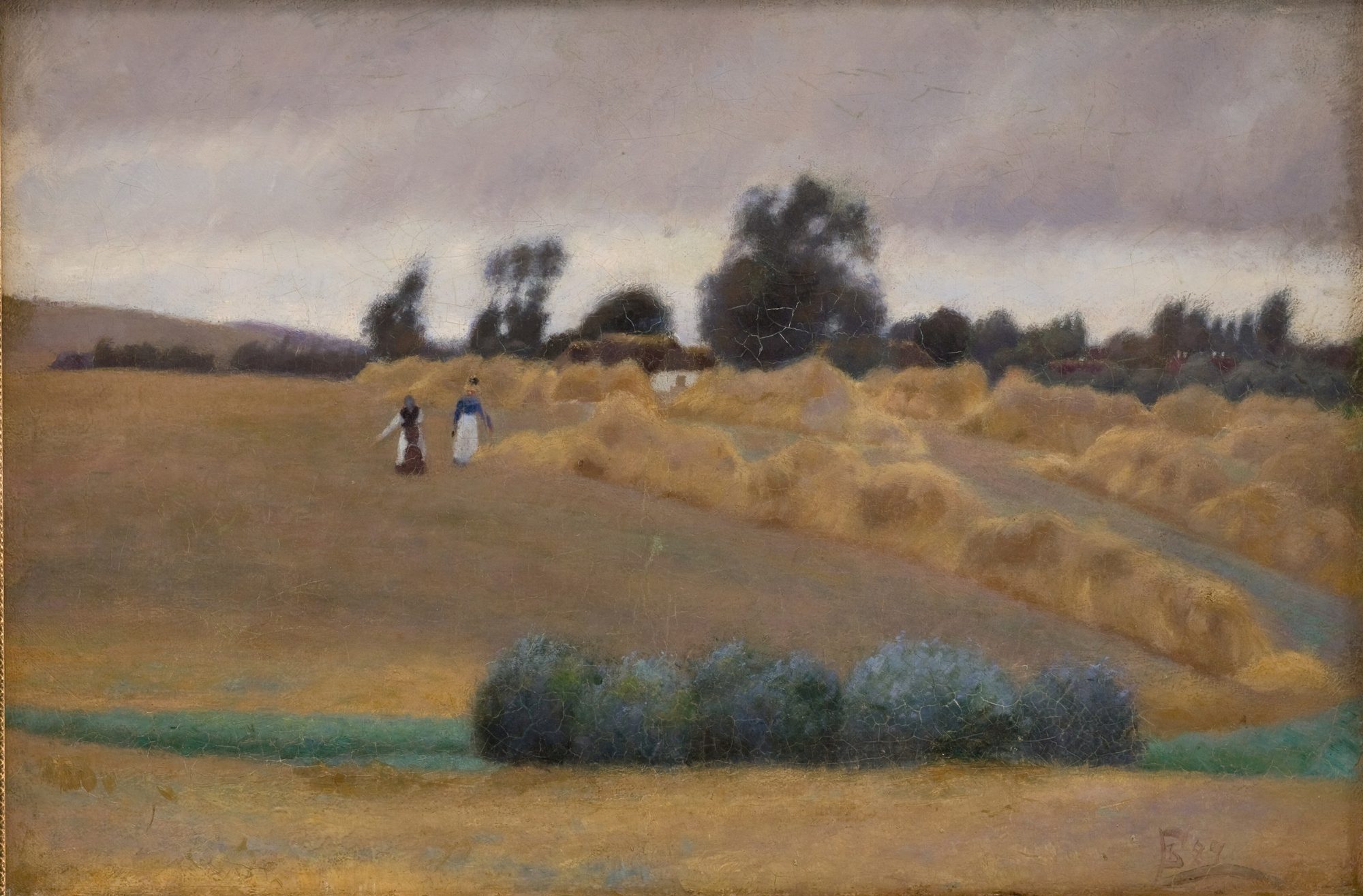
Roast badger, the village bull and a seed drill in flames
Small Stories from Byskov
Small and large moments from a little village - gathered from letters, memoirs and the minutes of the residents' association.
Byskov has never had a church, a school or an inn. But there has been no shortage of stories. Here is a selection of those the village's people have passed down - most of them from the book Byskov - herfra min verden går.
Birch Kristoffer, the village bull
On 18 June 1922, the Byskov Cattle Breeding Society was founded. Or rather, a bull station, for according to the minute book the society had only one purpose: to buy a bull of the Red Danish Dairy breed. Fifteen members with 83 cows between them joined forces, took out a loan of 2,000 kroner and bought the bull. His name was Birch Kristoffer.
Farmer Chr. Jensen was appointed keeper, one year at a time. He was paid 1.50 kroner a day - and free covering of his own eight cows. Should the bull prove "fiery", he could, to a limited extent, also be hired out beyond the members' 83 cows, naturally at a higher price.
In August 1925 the committee began thinking about "fresh blood". Birch Kristoffer was put up for auction among the members, and the hammer fell at 1,000 kroner - to Chr. Jensen. The proposal to buy a new bull was shelved, and so was the minute book. The society never got further than its very first committee.
The story, incidentally, was written down by Hans Suhr of Vægtergården.
Bodille at the cattle show
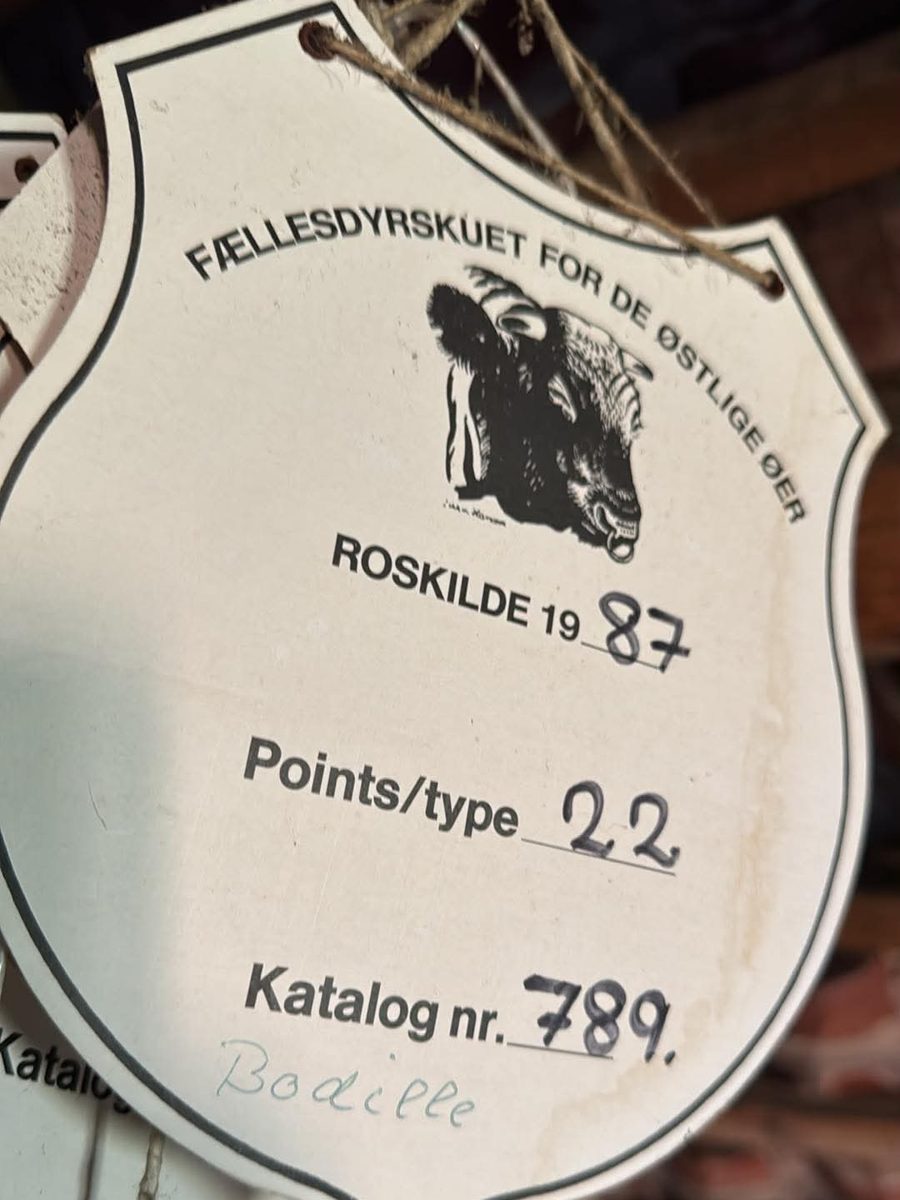
Up in the loft at Vægtergården hangs a whole row of show plaques on strings - many of them from the great bull Tarzan. One is from the Joint Cattle Show for the Eastern Islands (Fællesdyrskuet for de østlige øer) in Roskilde, 1987: catalogue number 789, 22 points for type. Underneath, someone has written in blue biro: Bodille.
Like Tarzan and the other animals on the plaques, Bodille was a Simmental, a big, sturdy breed of cattle from Switzerland. The cow belonged to Hans and Kis Suhr, and she was named after Bodil from the smithy across the pond - the eldest daughter of the blacksmith Alfred Jørgensen, who as a young girl had been in service at Vægtergården. Bodil was the grandmother of Lars Sommer, who owns the farm today. So the plaque bearing her name now hangs in his own loft.
The badger served as mutton
In 1888 Rasmus Kristiansen settled as a smith in Byskov, on a small smallholding by Lille Byskovvej. He and his wife Amanda had 13 children, and the household was poor.
One day Amanda served Rasmus some meat. It was Niels Sommer's ram, she said - and Rasmus was most pleased with it. Once he had eaten, she told him the truth: it was a badger that Johansen of Skovbjerggaard had shot. "Smith Rasmus" had a reputation as a hot-tempered man, and he threw the gnawed bones after Amanda.
He lived, incidentally, to be 90. The old smithy still stands on Lille Byskovvej.
The ice-mill on the village pond
When the village pond had frozen over, the children of Byskov built an ismølle - an "ice-mill". A post was driven down through the ice to the bottom, left standing a metre proud, and a long pole was fixed to the top with a stout nail. A hook on the end of the pole let you hitch on your sledge. A group of children would then push the pole round, and the sledge picked up a fair turn of speed. It was no joke at all if it tore itself loose.
Once the ice-mill had gone out of fashion, children instead chopped the ice into floes - "camper" or "klamper" - and jumped from floe to floe to avoid falling into the icy water. Mogens Sommer, who told the story, tried falling in himself once. "But it wasn't so bad, really, since I lived right by the pond."
In summer the farmhands rode the horses through the pond to rinse the mud from their legs, and the children were sometimes allowed to ride along. And all year round, of course, there was Tang Rasmus to watch out for.
The letters from Skovbjerggaard
From 1888 to 1892, Lene Pedersen of Skovbjerggaard wrote letters to her son Laurits, who was studying theology in Copenhagen. The letters have survived, and they offer a rare glimpse into everyday life in Byskov more than a hundred years ago: the harvest that went on past nine in the evening, the malt that had to be milled, and the old folks' feast where the farmers of Byskov and Klodskov danced until two in the morning.
On 8 May 1892 she wrote: "Last Friday Vægter's Hans had his wedding, we had all been invited." It was Hans Olsen Vægter of Vægtergården who was getting married.
That same year she wrote about a disaster. The farm of her neighbour Hans Larsen burned from four in the afternoon until well into the evening. It was thought that the children had been playing with matches and had set the stacks alight. The beet girls, who were pulling beets nearby, raised the alarm at once, and Gunilla carried clothes out of the house until the ceiling came down. The family managed to save almost all their belongings and animals - and afterwards lived with the Pedersens at Skovbjerggaard while the farm was rebuilt. "It takes no small amount of food, mind, to feed such a large family," wrote Lene.
When the neighbours pushed the seed drill back into the fire
Byskov has had its fires. In 1916 lightning struck Rudolf Davidsen's property, and his seven-year-old daughter Hedvig stood at the neighbour's window and watched her home burn. In 1952 lightning struck Georg Andersen's thatched roof on Klodskovvej, and the fire brigade drove the wrong way, for in those days there were neither road numbers nor house numbers - and it was raining, so the smoke couldn't be seen.
But the best fire story dates from 1938, when Carl Nielsen's thatched house on Lille Byskovvej burned to the ground. Carl Nielsen owned a seed drill together with several neighbours. The agreement was that he housed the machine while the neighbours paid the fire insurance. When the neighbours arrived at the fire, they saw that Carl Nielsen had managed to pull the seed drill out. They found this a bit too convenient - they had, after all, been paying the insurance for years - so they pushed it straight back into the burning house.
That was a bad idea. Carl Nielsen, it turned out, had never got round to insuring it. The neighbours decided he would not be included in their next seed drill.
For many years Byskov had its own firemen. In 1962 there were seven of them, with farmer Harry Christensen as fire chief - and smith Alfred Jørgensen of the Smithy as one of the firemen. Their most important task was to keep a fire-watch for as long as there was any fire left burning.
Himmerighuset, the House of Heaven
In the middle of Byskov, behind and to the east of Vægtergården, there once stood a small house with a beautiful name: Himmerighuset - "the House of Heaven". It was named after a former occupant, tenant and gate-keeper Niels "Himmerig" ("Heaven"), who was responsible for the gates in the fences between Byskov and the neighbouring villages. Later the owner ran an illicit tavern in the house - it got noisy, and in the end the house was torn down.
Around 1860 the parish wanted to buy the house as a poorhouse for the parish's elderly and sick. It would have cost 300 rigsdaler. But farmer Peter Vægter of the other Vægter farm voted against it, because the house stood too close to his own farm - and in those days the parish could not force a purchase through. Peter Vægter's objection meant that no one in Byskov ever got a poorhouse for a neighbour.
Village of the Year
For a number of years, Nørre Alslev Municipality chose a "Village of the Year", and in 1995 Byskov was named Village of the Year for 1996. The criteria were activity and strong community spirit. On Saturday 16 September 1995 the award was presented to the residents' association over coffee at Skovbjerggaard, where the mayor made a speech and gave 2,000 kroner to the association's funds - towards a playground, among other things. And signs went up on the roads into the village, so that everyone could see Byskov is a good place to be.
Sources: Ketty Lykke Jensen, Byskov - herfra min verden går (2010): Hans Suhr on the bull society (p. 43), the smiths of Byskov (pp. 38-39), Mogens Sommer's memories of the village pond and the fires, the letters from Skovbjerggaard 1888-92, the poorhouse (pp. 30-31, 126) and "Byskov - Village of the Year". Bodille: the show plaque in the loft at Vægtergården and the family's own account.