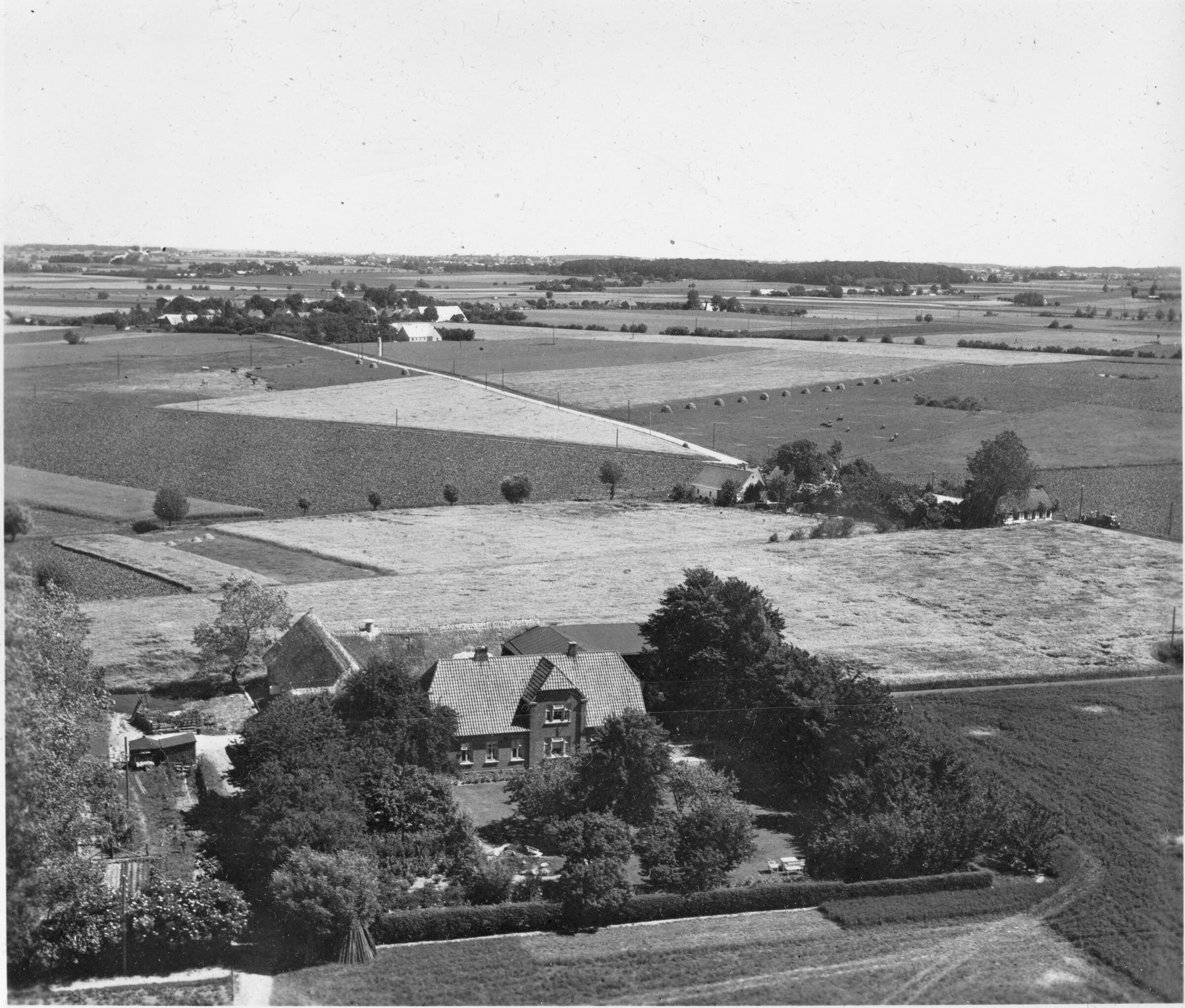
The night of 21-22 April 1943
The bombing night in Byskov
On a moonlit April night some 300 phosphorus bombs fell over Byskov. One burned twenty metres from the Smithy, another behind Vægtergården's stable.
In the Second World War, bombs in Denmark fell almost only on Copenhagen and Bornholm. But Byskov had its own bombing night, and for the rest of the war people did not dare go to sleep when planes flew over.
"It's going to be a hot night!"
It was still and moonlit. Karen and Svend Suhr of Vægtergården were walking home from a party when they heard planes heading south. "It's going to be a hot night!" said Svend - not knowing it would be in Byskov. A British bomber wave, perhaps bound for Berlin, was intercepted by German fighters, and in their flight one or more planes dropped some 300 phosphorus bombs in a line across the village and on over Skovbjerggaard's fields.
In the Smithy
Karla Jørgensen drew the blackout curtain aside and saw a big bomber glide low over the garden. She heard a hiss, ducked under the window - and the bedroom lit up: a phosphorus bomb was burning twenty metres from the house.
At Vægtergården and the mason's house
Svend Suhr woke to what he took for rifle fire: bombs exploding in the fields. One had fallen a hundred metres behind his stable. Then he heard shouts from the mason Georg Nielsen's house, where a bomb burned in the loft by the only stairs. Their 17-year-old son Ove climbed out of a window and down a pear tree, fetched a ladder for his parents and ran to phone the fire service. Svend Suhr broke down the locked kitchen door, and the bomb was put out with earth and water.
The next day
A bomb-disposal unit from Næstved collected most of the 300 bombs. Each was hexagonal, a little smaller than an old-fashioned thermos, with a lump of lead at one end.
Source: Mogens Sommer, "Byskovs bombardement", in Byskov - herfra min verden går (2010), pp. 45-47.