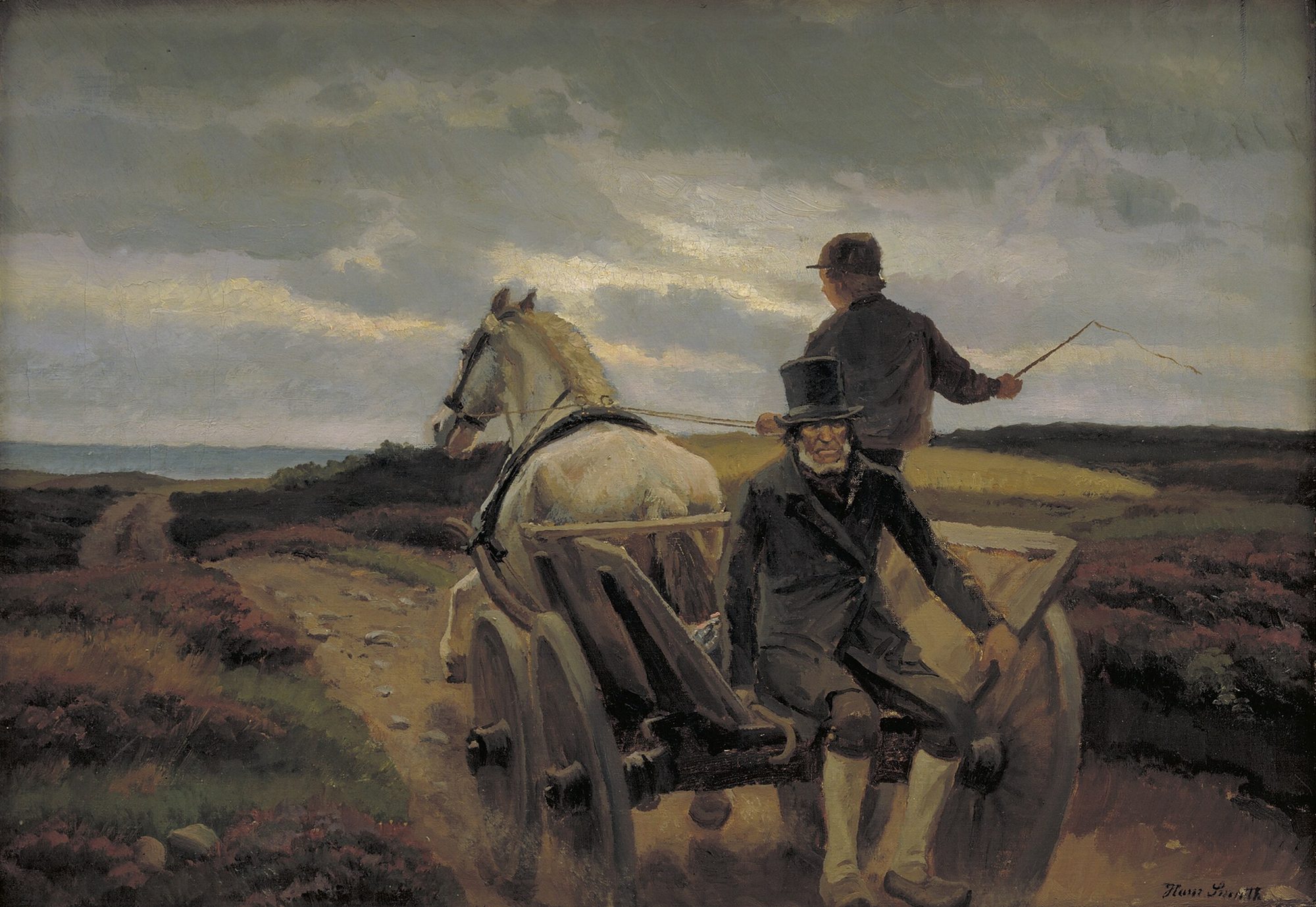
The inn by the place of execution
The Gallows Inn
Its real name was Ludvigslund. But since it stood right by the district gallows, everyone called it the Gallows Inn.
On the old, winding road between Nykøbing and Gåbense ferry crossing stood an inn officially called Ludvigslund. But it stood right next to the district's place of execution, and in everyday speech it got a rather more sinister name: the Gallows Inn.
It was good business. The inn stood where people passed on their way to and from the ferry, and the place of execution next door brought plenty of custom. Here people fortified themselves with food and drink when they had travelled a long way - or when they had just watched an execution. On the Royal Danish Academy of Sciences' map of Falster from 1772, "Galgen" (the Gallows) is marked between Byskov and Ønslev.
The mail coach in the November mud
The inn also had a postal office, so the royal mail coaches stopped here, both for the travellers' sake and to change horses. The clergyman Johannes Fibiger, who later became parish priest and found the frescoes in Eskilstrup Church, paints a picture in his memoirs of what it looked like in 1822, when his family left Falster because his father had been made headmaster in Kolding. He was a small child at the time.
It was November weather, and through the mud laboured a coach that hung on leather straps. It was covered over with leather dressed in train oil, with holes here and there so the travellers could see out - and so it wouldn't rain in, glass was sewn into the holes. On the box sat the coachman in a red jacket with a yellow collar, light-blue trousers and a tall hat with a white band, and over his shoulder hung a dented brass horn.
The road is a fairly newfangled convenience, yet the railway has already made it old-fashioned.
The end of the inn
In 1801 the innkeeper Toxværd still lived there, aged 67. Later it came under the farm Boderup. Around the middle of the 1800s the highway was rerouted further west, roughly where it runs today, and the inn suddenly found itself off the road. In 1863 the new Højmølle Inn on the highway was granted the licence instead.
The Gallows Inn was converted into housing for three families who worked at Boderup. On 12 August 1890 it burned down. The fire was caused by a paraffin lamp on a shelf close under the ceiling. A new house was built - but deliberately not on the same spot. That way it escaped inheriting the name.
The Gallows Inn stood on the same old road as the King's Oak and the Parson's Wife.
Sources: Ketty Lykke Jensen, Ønslev og Eskilstrup Sogne (2009), pp. 67-68, with quotations from Johannes Fibiger, Mit liv og levned · Royal Danish Academy of Sciences' map of Falster, 1772 (Danish Agency for Climate Data, Historical Maps).